Last fall, Timken’s teams in Chengdu, Suzhou, and Wuxi welcomed a group of young visitors. High school, vocational school, and college students participating in the Junior Achievement China (JA China) program toured the factories, observed production lines, took part in skills workshops, and spent half a day shadowing engineers.
This “shadow day” workplace experience was documented in Timken’s 2025 Corporate Social Responsibility Report, released on September 29. Centered on the three pillars of “People, Planet, and Products,” the report highlights our actions and progress in advancing corporate social responsibility globally.
Being a responsible company means integrating responsibility into everything we do—from how we operate to how we give back to our communities.
— Lucian Boldea
President and CEO, Timken Company
TimkenTimkenTimken
A Downward Curve
Timken
Progress in emissions reduction can be seen in a single curve. As of 2025, our Scope 1 and Scope 2 greenhouse gas emissions intensity has decreased by 48% compared to 2018, and we are on track to meet our 2030 target of a 50% reduction.
Emissions intensity is calculated based on revenue (in U.S. dollars) and measures the amount of greenhouse gas emissions per unit of revenue. Scope 1 primarily refers to direct emissions from company facilities and vehicles, while Scope 2 primarily comes from purchased electricity. Improving our energy mix and enhancing equipment energy efficiency are concrete pathways to driving emissions reductions.
TimkenTimkenTimken
Making Better Use of Resources
Timken
By 2025, 23 factories worldwide were utilizing biomass, solar, wind, or hydroelectric power, with renewable energy usage reaching 21 times the 2018 level—avoiding approximately 60,000 metric tons of CO₂ equivalent emissions that year.
From 2023 to 2025, we invested more than $13.4 million in energy efficiency and emissions reduction projects, many of which originated from improvement suggestions made by employees. We also made progress in waste management: In 2025, 86% of waste was diverted from landfills, and annual waste generation was reduced by 41% compared to 2018.
TimkenTimkenTimken
Daily Improvements at Chinese Plants
Timken
In China, energy conservation and emissions reduction are also reflected in specific improvements at our plants.
The Chengdu photovoltaic project, completed in 2025, prevents hundreds of metric tons of CO₂ equivalent emissions and reduces annual energy costs. Wuxi expanded its waste heat recovery system to capture heat lost during production and use it for heating and preheating, saving 405,000 kWh of energy annually. Yantai introduced electric forklifts for on-site material handling.
Wuxi has also introduced eddy current testing equipment with an integrated vision system into key quality inspection processes, automating what was previously a manual inspection step. The equipment provides real-time defect and traceability data, helping to reduce scrap, while allowing operators to shift to other, higher-value tasks.
TimkenTimkenTimken
Safety Starts with the Details
Timken
Improvements to the workplace also rely on employees’ timely identification of safety hazards. The “Good Catch!” hazard reporting program encourages employees to proactively identify and report potential hazards before they escalate into accidents.
The program was piloted in North America in 2023, with the first two phases of rollout completed in 2025; it is scheduled to cover all global operations by 2026. As of December 2025, employees had submitted nearly 7,000 hazard observation reports, 88% of which have been fully resolved.
Employees also participate in improving workstations and operational processes. The Ergonomics Challenge (Ergo Cup), launched in 2011, has received nearly 1,000 ideas to date; in 2025 alone, 95 proposals were submitted—a record high. Since 2011, ergonomics-related injuries at the company have decreased by 70%.
TimkenTimkenTimken
From the Classroom to the Future
Timken
Our focus on people also extends to young people exploring their future careers. Through our “Shadow Day” program, our employees partner with Youth Achievement China to give students the opportunity to experience the daily work of engineers and understand the connection between what they learn in the classroom and their future career paths. In addition to providing on-site learning opportunities, we also provide teaching resources and materials for STEM (science, technology, engineering, and mathematics) education in China to support teachers in their instruction.
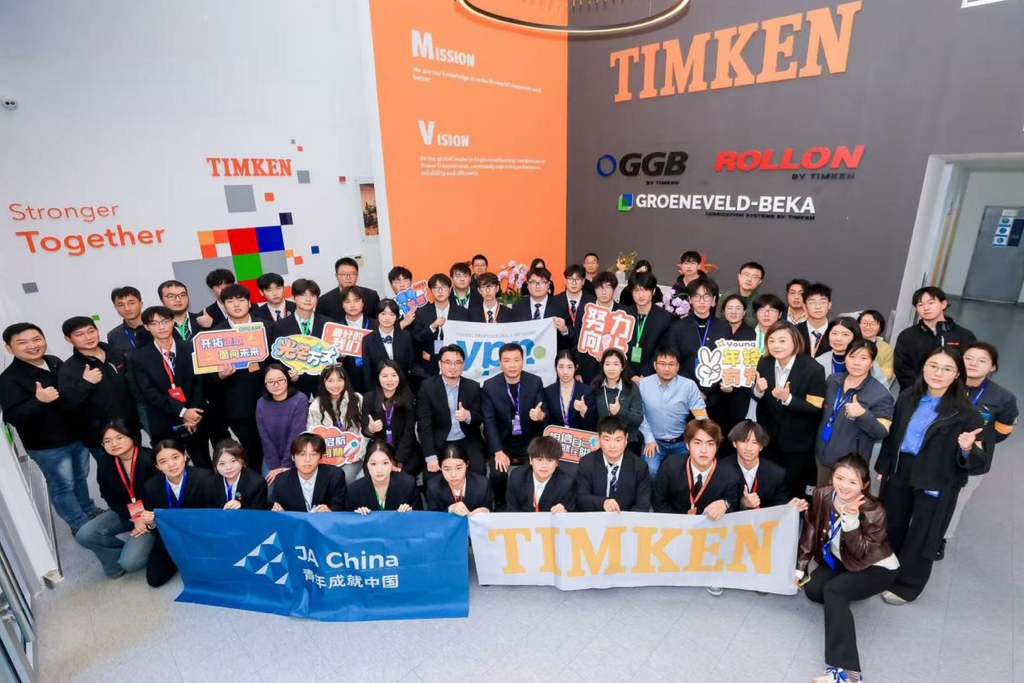
On-Site Photos from “Shadow Day”
We leverage our global engineering expertise to drive energy conservation and carbon reduction in our operations in China, and support the growth of the next generation through employee development and community education. Our ongoing commitment to environmental and social responsibility is the cornerstone of Timken’s long-term development in China.
— Yu Lan
President, Timken China and Northeast Asia